Sylt Mya II
HMC conference Cologne
HMC Conference took place this year for the first time as a non-virtual event. This was a great opportunity to get to know the latest developments and discussions in the field of metadata.
Monday started leisurely with a slot reserved for workshops. STAMPLATE & the DataHub Digital Ecosystem: Towards a FAIR Research Data Infrastructure for Environmental Time-Series showed in a very enthusiastic manner the benefits of modern (geo-)data standards. Originated from a HMC project the sensor things api (STA) is the foundation for a wide field of applications. The metadata management systems SMS and O2A REGISTRY are facilitated to generate the entire metadata section of the STA standard and the underlying FROST server stores the time series values. In this workshop the saQC framework (10.5281/zenodo.5888547) was used to apply qc routines.
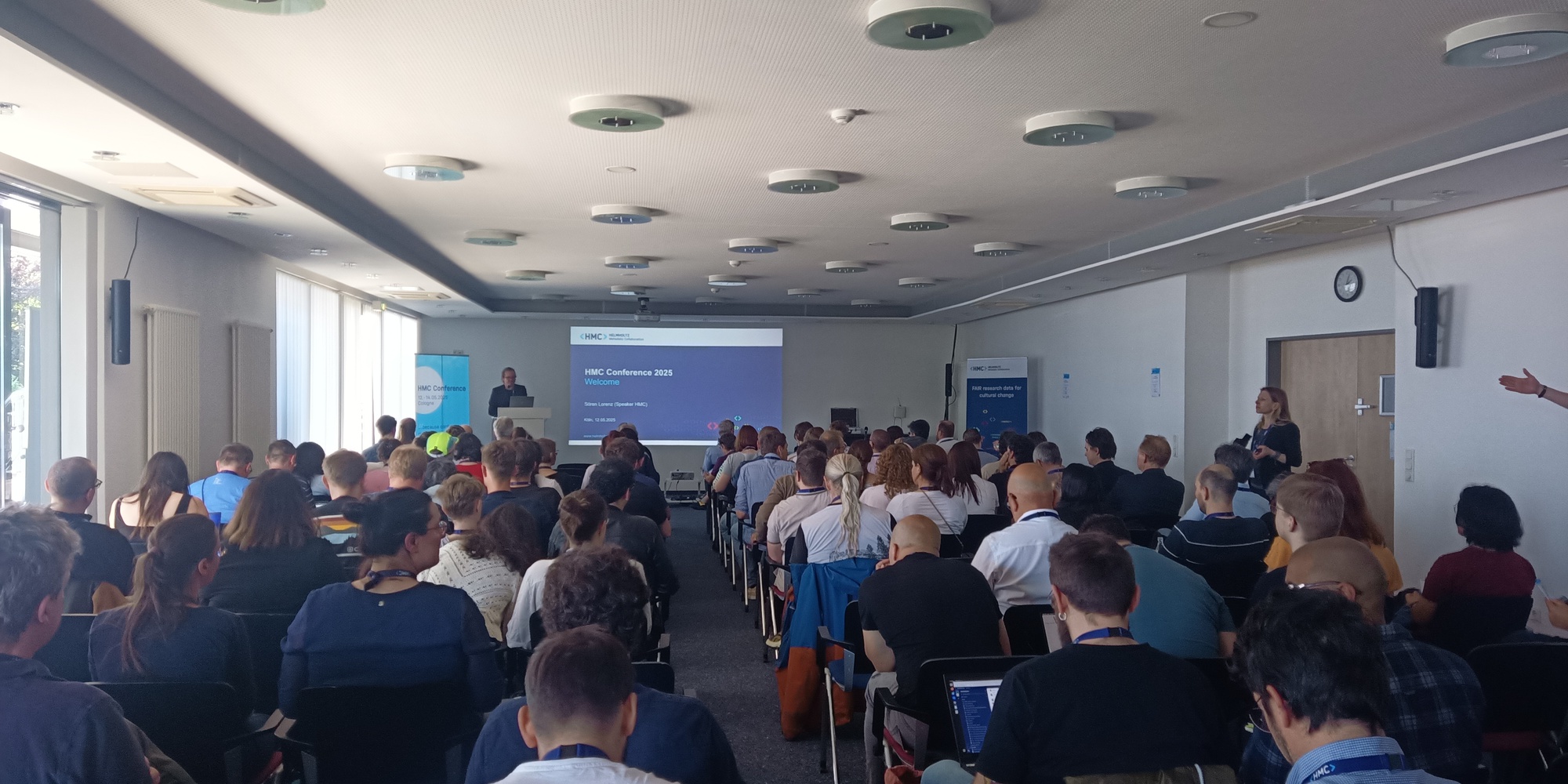
After the official opening, including a welcome message by O. Wiestler (President of Helmholtz Association of German Research Centres) himself in a critical, but enthusiastic keynote Simon Hodson from The Committee on Data of the International Science Council, FRANCE (CODATA) was asking What is FAIR for? Some thoughts on progress, directions and priorities and concluded that HMC as an initiative is the absolutely right way to go by addressing metadata exclusively and not treat it as a cumbersome byproduct.
In another keynote Till Korten from Helmholtz-Zentrum Dresden-Rossendorf (HZDR) showed that Data Management Makes Machine Learning Easier and how many time and thus effort and money is saved if proper data management was made and that in this way more time can be put to the genuine work.
Poster session time was DLS time. We are participating in an ad-hoc working group on metadata semantics (sidekick of datahub AK Metadata) and presented the intended approach to create a common Helmholtz E&E vocabulary for device types. We did not expect such an eager interest. The whole session we were not able to grab some of the also served cookies and cake, because we held very interesting discussions and answered a lot of questions about the how and why of this endeavor. Still hungry but very pleased we closed the session after almost two hours. The contribution is available via zenodo.
Kottmeier, D., Anselm, N., Baldewein, L., Börner, G., Brinckmann, N., Fösig, R., Huber, R., Malinovskiy, S., Mühlbauer, F., Pörsch, A., Rebmann, C., Remmler, P., & Söding, E. (2025). Towards a Common Controlled Vocabulary for Device Types in Helmholtz Research Area Earth and Environment (1.0). HMC Conference 2025, Cologne. Zenodo. 10.5281/zenodo.15411230
Two and a half days full of great impressions and also a lot of input to think about it at the home institutions.
MUSE workshop Hamburg

This week, components of the O2A data flow framework — REGISTRY, INGEST, and DASHBOARD – were presented at the MUSE workshop in Hamburg by colleagues from the DATA department of the AWI Computing and Data Centre.
INFO
MUSE ("Marine Environmental Robotics and Sensor Technologies for Sustainable Research and Management of Coastal, Ocean, and Polar Regions") is a collaborative infrastructure initiative by GEOMAR, hereon, and AWI. The workshop took place at the Climate Service Center Germany (GERICS) and was hosted by hereon.

The event focused on fostering synergies between the participating research centres and sharing progress across the project's four main tasks:
- Task 1 – Sensor systems
- Task 2 – Payload and platform interfaces
- Task 3 – Data solutions
- Task 4 – Energy solutions
MUSE brings together scientists, engineers, technicians, and data managers across institutions to build a shared technological foundation for marine environmental research.
The 15 presentations illustrated that several MUSE sensors are already being deployed in the field, while other technologies remain in active development and construction. Furthermore, the workshop provided space for discussions on future applications and integration strategies. A highlight was the prototype showcase by the hereon team, led by Dr. Lucas Merckelbach and Dr. Prokopios Georgopanos, presenting their progress in Task 4: "Energy Solutions" (Merckelbach and Georgopanos 2025).
Projects like this highlight that it is not only advanced robotics that move us forward, but the shared infrastructure and collaborative ecosystems we create around them.
Merckelbach, L., & Georgopanos, P. (2025). A Fuel Cell Power Supply System Equipped with Artificial Gill Membranes for Underwater Applications. Advanced Science, 2410358.